
Services
Our services
From diagnosis to contract research: nine ways we help you turn a question into evidence you can act on, whether you rear insects, keep bees or develop agrochemicals.
How we work
From first call to actionable report
01
Tell us your challenge
Share your species, facility and the question you need answered. We reply within two business days.
02
Sample plan & shipping
Before you collect anything, we send you clear instructions: how many insects to sample, how to preserve them and how to ship them.
03
Analysis
Genomic, molecular and bioassay work carried out at our laboratories, located in the Scientific Park of the University of Valencia.
04
Report & next steps
A clear client report with results, interpretation and a recommended action plan.
Jump to a service
Diagnostics
De novo pathogen screening
Are you facing high mortality in your insect rearing and don’t know why? We identify the cause, even when you don’t know what to look for. If you want to cut the cost of disease outbreaks, this service is for you.
Describe your case →The challenge
Disease in insect rearing often starts silently. By the time mortality, slower growth or failed pupation become visible, a pathogen may already have spread through the colony. Finding the cause is rarely simple: viruses, bacteria, fungi and microsporidia can produce similar symptoms, and some infections remain covert for generations before an outbreak.
Our service
De novo pathogen screening does not require you to know in advance which pathogen to test for. We sequence the genetic material present in healthy and affected insects using high-throughput sequencing, and analyse it with our bioinformatic pipelines against curated reference databases. This detects viruses, bacteria, fungi and other microorganisms, including agents never described before in your species. You receive a clear report with the agents detected, their relative abundance, which of them are most likely linked to the problem, and recommended next steps for control and follow-up monitoring.
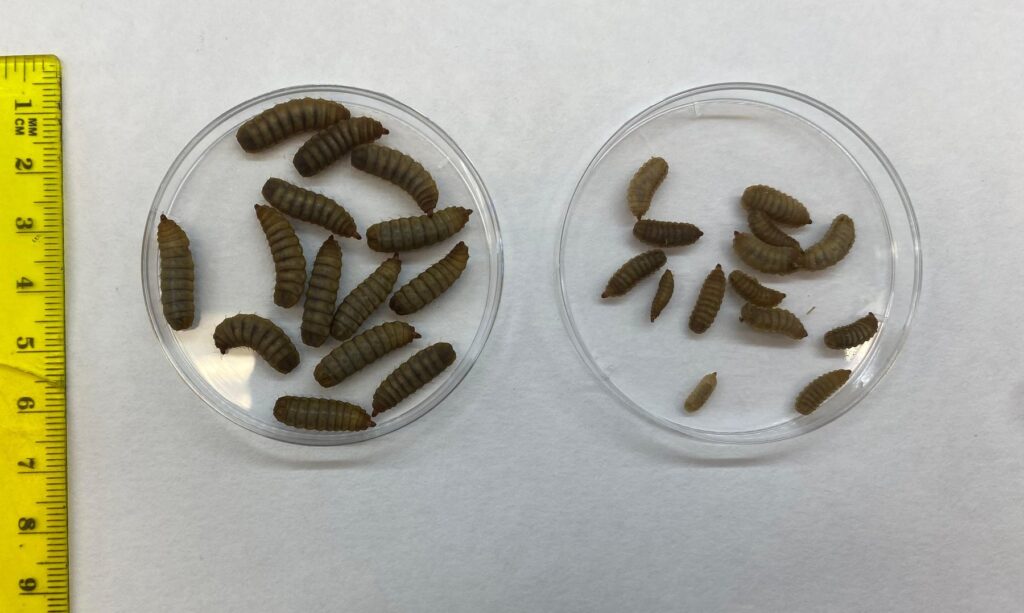
Black soldier fly larvae from a healthy batch (left) and larvae affected by a pathogenic bacterium (right), showing reduced size.
Let’s talk
Every outbreak is different. Tell us what you are observing in your rearing, and we will propose a sampling and analysis plan adapted to your species, your facility and your budget.
Diagnostics
Pathogen detection and management
Monitoring and prevention are the keys to keeping disease out of your insect colonies. Know the health status of your production before symptoms appear, and act before losses do.
Plan your monitoring →The challenge
Once a pathogen of concern is known, the priority becomes keeping it under control. That means testing regularly at a cost that makes routine monitoring viable.
Our service
This service targets one or several specific pathogens with dedicated molecular assays (such as qPCR). Because the test is focused, a much larger number of insects can be analysed at a lower cost per sample than with sequencing-based approaches. By measuring pathogen presence and load over time, across batches or between rearing rooms, we help you detect infections before disease develops, check whether hygiene and management measures are working, and document the health status of the insects you sell, buy or exchange.
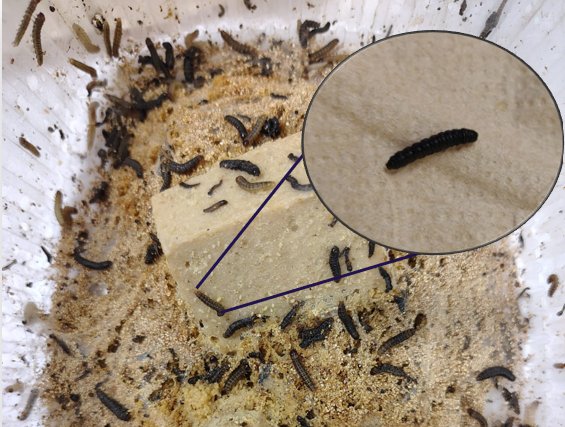
Lepidopteran larvae in a rearing container, with a diseased larva shown in the magnified inset.
Let’s talk
Each monitoring programme is built around your production: species, batch sizes, sampling frequency and the pathogens that matter to you. Contact us and we will design a monitoring plan tailored to your facility.
Diagnostics
Insect microbiome characterisation
Many labs can sequence a microbiome, but few specialise in insects. We work with insects every day, and we choose the technique (amplicon sequencing, metagenomics or metatranscriptomics) that fits your samples, your question and your budget.
Ask about your project →The challenge
The microorganisms that live in and on insects influence their nutrition, development and immunity, and even how they respond to pathogens and pesticides. Characterising them can explain why colonies, diets or populations perform differently. Getting reliable answers, however, depends on decisions that generalist sequencing providers rarely make for you: which tissues to sample, how to extract nucleic acids from insect material, and how to interpret the results in a biological context.
Our service
We start from the insect. We help you design the sampling, dissect specific tissues such as the gut when needed, extract DNA or RNA with protocols adapted to insects, and choose the most suitable strategy: amplicon sequencing (16S rRNA for bacteria, ITS for fungi) to describe community composition, shotgun metagenomics to explore functional potential, or metatranscriptomics to see which microorganisms are active. Bioinformatic analysis and interpretation are included.
Let’s talk
Tell us about your insects and what you want to learn from their microbiome, and we will recommend the most cost-effective approach.
Contract Research
Genetic optimisation
Would you like to select an insect population for a specific trait, or do you have a candidate gene you want to work with? We bring hands-on experience in genetic selection and CRISPR genome editing in lepidopterans and dipterans such as the beet armyworm or the black soldier fly.
Discuss your trait or gene →The challenge
Genetics is one of the most powerful levers for improving the productivity, robustness and value of reared insects, and a key tool for understanding the function of a gene. Yet developing an improved or edited line takes specialised skills at every step, from molecular design to insect handling and long-term rearing.
Our service
We work along two complementary lines. Selection and breeding: we identify and track genetic traits of interest with molecular markers, supporting selective breeding programmes while preserving genetic diversity. CRISPR genome editing: a complete process, not a single step. We cover the design of the guide RNAs, the preparation of the editing reagents, the microinjection of embryos, the rearing of the injected individuals, and the genetic analysis of the following generations to confirm that the edit has been introduced and is inherited, until a stable line is established.
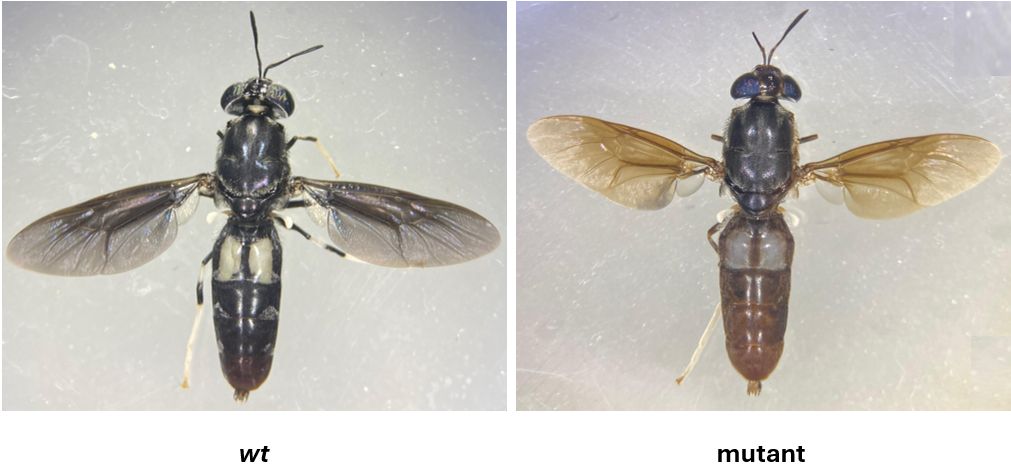
Black soldier fly adults: wild type (left) and a CRISPR-edited mutant with altered pigmentation (right).
Let’s talk
Tell us the trait or the gene you have in mind. We will assess feasibility for your species and propose a project plan with clear milestones.
Contract Research
Susceptibility & efficacy testing
Is your product still working in the field, or is a new compound ready to prove itself? Find out how your target pests really respond. Click to discover the species we work with.
Test your product →The challenge
When pest populations become less susceptible to a product, the consequences are extra applications, higher costs and lost crops. Knowing how susceptible each field population is, and how well a registered or candidate compound performs against it, is essential for choosing treatments, rotating modes of action and supporting product development.
Our service
We combine insect rearing and laboratory bioassays to measure the susceptibility of pest populations and the efficacy of your product. Our dose–response bioassays provide values such as lethal concentrations (LC50) and resistance ratios compared with susceptible references, and they can be complemented with molecular detection of known resistance mechanisms. Our team has long-standing experience in the ecology, evolution and molecular basis of pesticide resistance.
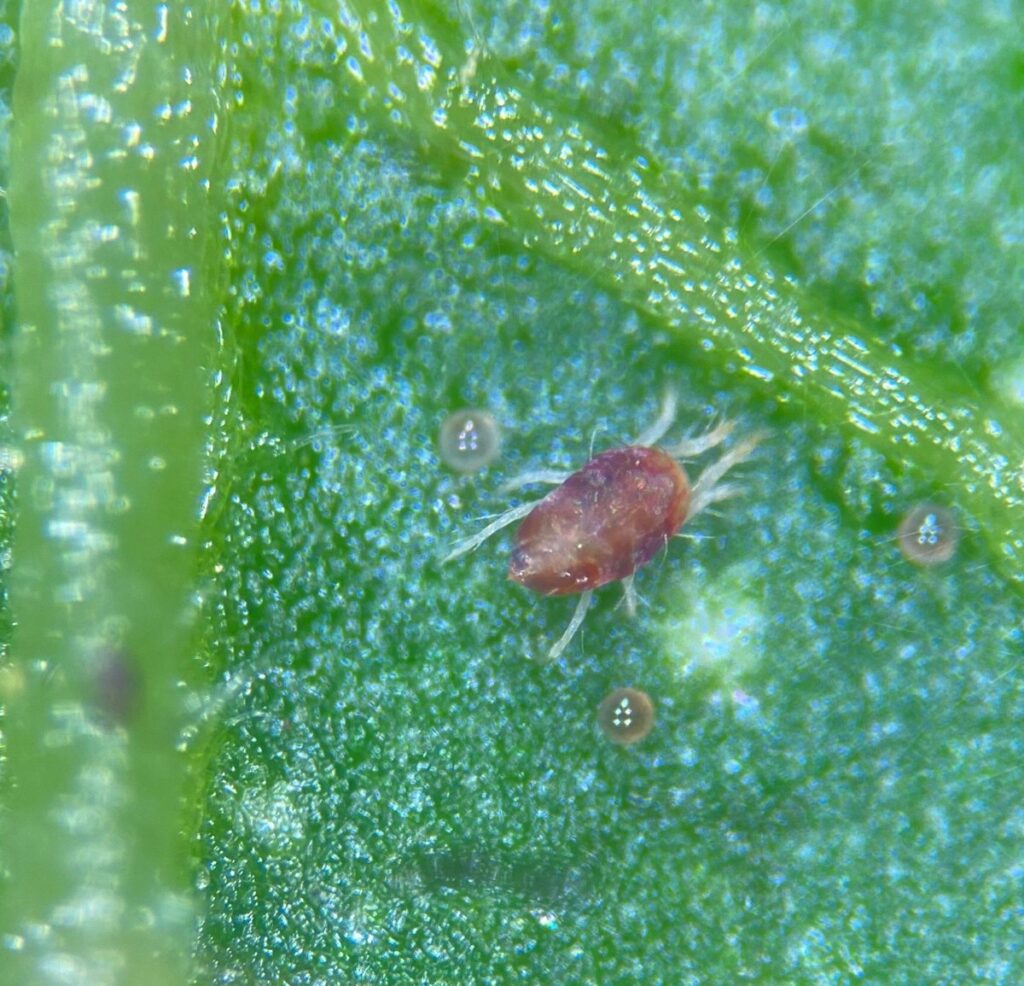
Two-spotted spider mite (Tetranychus urticae) female with eggs on a leaf.
Case study
For an agrochemical client, we received infested plant material directly from commercial fields in several European locations. We established each pest population in our rearing facilities, and then ran bioassays with the client’s product. The result: a clear picture of the susceptibility of each field population and of the product’s efficacy against them, delivered in one report.
Let’s talk
Tell us which pest, crop and product you are interested in, and we will design a testing programme adapted to your needs.
Contract Research
Toxicology assays
Developing a new plant protection product? Showing that it is safe for pollinators is a required step on the road to registration. We help you generate the data.
Discuss your compound →The challenge
Before a plant protection product can be authorised in the European Union, its risk to bees has to be assessed. Current EFSA guidance covers not only honey bees but also bumblebees and solitary bees. Generating reliable data early in development helps avoid surprises later in the regulatory process.
Our service
We perform laboratory bioassays to evaluate the effects of candidate compounds on beneficial insects such as the honey bee (Apis mellifera). These can be complemented with molecular studies of how the compound is metabolised by the insect, which helps to explain differences in toxicity between species and compounds.
Let’s talk
There is no single design that fits every product. We will discuss with you the most suitable species, exposure route and endpoints for your development stage and regulatory needs.
R&D
CRO services
Do you have an R&D project in mind but not the resources to carry it out? We can help. One team, from the insect to the data.
Start your project →The challenge
Research questions in crop protection, insect production and apiculture usually need several disciplines at once. Coordinating separate providers for rearing, bioassays, molecular work and data analysis is slow and costly, and important details can get lost between them.
Our service
Cucare covers the full stack in-house. Insect biology: colony rearing, handling of every developmental stage, and fine dissection of tissues such as brain, nerve cord or gut. Bioassays: efficacy, susceptibility and sublethal effects. Molecular biology: extraction of high-quality DNA, RNA and proteins, PCR and qPCR, and preparation of samples for sequencing. Sequencing and bioinformatics: genomics, transcriptomics and metagenomics, from raw data to interpreted results. A single scientific team designs the study, runs it and reports it.
Let’s talk
Tell us about your project, even if it is still an idea. We will reply with a proposal, a timeline and a quotation built around your objectives.
R&D
Consulting
Need an expert view on colony health, pest resistance or insect genetics? Talk to active researchers, whenever you need them.
Book a first call →The challenge
Not every question needs a laboratory project. Sometimes you need an informed second opinion: reviewing a rearing protocol, interpreting a test result, planning a resistance-management strategy or evaluating a new technology.
Our service
Our consultants are active researchers who combine academic depth with industry experience in insect pathology and diagnostics, pesticide resistance, insect genetics and genome editing, bacterial toxins and their resistance mechanisms, insect rearing, bioassay design, molecular biology and bioinformatics. Consulting is available per project or through a bag of hours: you buy a package of hours up front and use them in online meetings with our team whenever you need them, without negotiating a new contract for each question.
Let’s talk
Tell us what you need and we will recommend the format, a specific project or a bag of hours, that fits you best.
R&D
Research projects
Preparing a research proposal in insect science? We are happy to join your consortium.
Invite us to your consortium →Our service
Cucare takes part in collaborative R&D projects in any area of insect science, including insect health, insect production, pest management, pesticide resistance and insect genetics. We can join consortia as a company partner in Spanish, European and international calls, contributing laboratory capacity, specialised know-how and a route to application. Contact us early in the preparation of your proposal.
Not sure which service fits?
Answer two quick questions and we'll point you to the right one.
Open the service finder